Americans Owe More Than Ever. Should We Be Worried?
US household debt has reached a record $18.8 trillion, but not all borrowing carries the same risks. Here's how mortgages, credit cards, auto loans, student loans and personal loans compare, and what rising delinquencies reveal about household finances.
Americans owe more than at any point on record. At the start of 2026 total household debt reached a record $18.8 trillion, according to the Federal Reserve Bank of New York. That is not a one-off spike. Apart from a stretch of belt-tightening after the 2008 financial crisis, household borrowing has climbed almost every quarter for two decades.
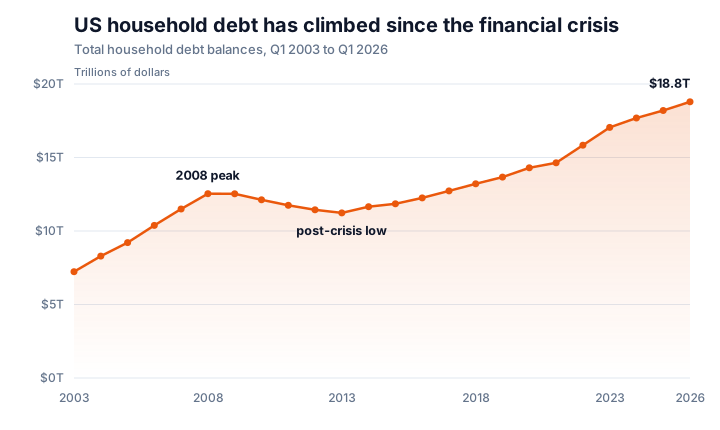
Source: New York Fed Household Debt and Credit Report data, Q1 2026.
The last time the total fell was during the "great deleveraging" between 2008 and 2013, when balances dropped for nine straight quarters as households paid down debt and lenders tightened up. Debt bottomed out in 2013, passed its old 2008 peak in 2017 and has been setting new records ever since.
Some of that climb is just inflation. As prices rise, so do the dollar figures on everything people finance, from cars to the groceries that land on a credit card, so we would expect the totals to drift up even if borrowing habits never changed. But debt has outpaced inflation rather than merely tracked it. Consumer prices rose just under a quarter over the past five years, while total balances grew faster than that. Credit card debt alone is up 63% over the same stretch.
It also obscures an important point: not all debt is the same. A $400,000 mortgage on a house and a $6,000 balance on a credit card at 22% both count toward the total, but they do very different things to your finances. So it helps to take the $18.8 trillion apart and look at where the borrowing is really growing.
Mortgages: the biggest balance, and the least worrying
Mortgages are by far the largest piece of the pie. At $13.19 trillion they make up roughly 70% of all household debt, with another $446 billion in home equity lines of credit on top.
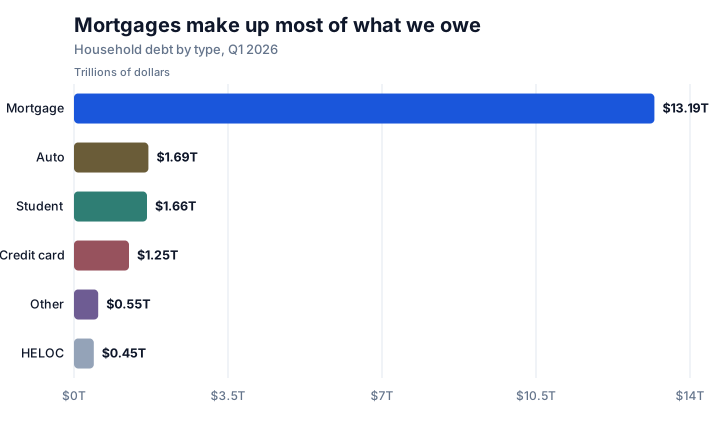
Source: New York Fed Quarterly Report on Household Debt and Credit, Q1 2026.
If most of what we owe is mortgage debt, why is that the part to worry about least? A mortgage is unusual among debts in a few ways. It is tied to an asset that has historically tended to appreciate over long periods, so the loan tends to shrink while the thing it paid for grows. American homeowners with mortgages are collectively sitting on around $17 trillion in home equity, which is the flip side of all that mortgage debt.
It is also cheap and predictable relative to other borrowing. Most US mortgages carry a fixed rate locked in for 15 or 30 years, so the payment does not move when interest rates do, and many homeowners are still holding the low rates they secured a few years ago, when rates were at unprecedented lows. A mortgage payment even works a little like forced savings: each month a slice goes toward principal, building equity you can eventually get back.
None of that makes mortgage debt risk-free. Borrow too much relative to your income, buy at the top of a hot market or lose the paycheck that covers the payment and a mortgage becomes a serious problem. But as a category, it is backed by an asset, priced reasonably and rarely delinquent (the 2008 financial crash being a major exception). Historically, unsecured debt such as credit cards has produced higher delinquency rates and higher borrowing costs than mortgages.
Credit cards: a smaller balance, a bigger problem
Credit card debt is a fraction of the mortgage total at $1.25 trillion, but it is the balance most likely to cause real damage. It is also growing fast. Card balances are up 63% in five years, climbing $482 billion from a pandemic-era low of $770 billion in early 2021.
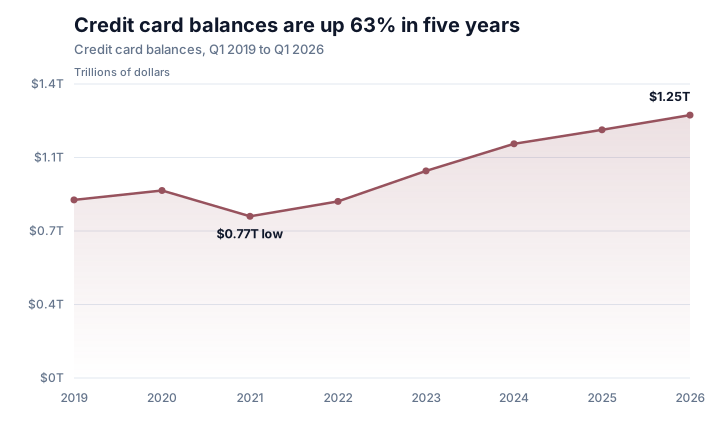
Source: New York Fed Household Debt and Credit Report data, Q1 2026.
Some of that rebound is normal. Balances collapsed in 2020 and 2021 as spending dried up and stimulus checks went toward paydowns, so part of the rise since then is just a return to trend. But balances have kept climbing well past where they were before the pandemic. Higher prices may have contributed to more households relying on credit cards for everyday spending, and more of it is being carried from month to month.
That last part is what to watch. Roughly half of cardholders now carry a balance rather than clearing it in full, and the share has climbed back from its pandemic low, from 39% at the end of 2021 to about 47% at the end of 2025. And it is not spread evenly. The Federal Reserve's survey of household finances finds that carrying a balance is concentrated among lower- and middle-income households, with over half of cardholders earning under $100,000 revolving a balance from month to month. It is more common among Black and Hispanic adults.
What people borrow for matters as much as how many people borrow. According to public surveys, a growing share of card debt is going toward day-to-day essentials rather than one-off purchases. Among cardholders in debt, the share who blame everyday costs like groceries, utilities and childcare as the main driver of their balance rose from 26% in 2023 to 33% in 2025. That fits a wider squeeze. The same Fed survey found that 37% of adults could not cover a $400 emergency expense with cash, and for many the fallback is a credit card. Borrowing to cover recurring household expenses may indicate greater financial strain than borrowing for a one-time discretionary purchase.
What makes credit card debt different from a mortgage is the cost and the lack of anything behind it. The average interest rate on credit card accounts sits around 21%, several times what a mortgage or auto loan charges and there is no appreciating asset attached. Carry a balance and the interest compounds against you. Pay only the minimum and a modest balance can take years to clear and cost more in interest than the original purchases.
Example
Say you owe $5,000 on a card at 21% and pay $150 a month toward it. It would take roughly four years to clear, and you would pay around $2,500 in interest on top of the original $5,000. The higher the rate and the smaller the payment, the longer that tail gets.
The strain is starting to show. The New York Fed reports that 4.8% of all household debt is in some stage of delinquency, with credit cards among the categories where borrowers are falling behind. Because of its high interest rates, financial planners often recommend paying down revolving credit card balances before lower-rate debt.
Auto loans: record balances and bigger monthly bills
Auto loans are the second-largest category after mortgages, at $1.69 trillion. Outstanding car debt has risen 57% since 2016, and like most of this list it keeps setting records.
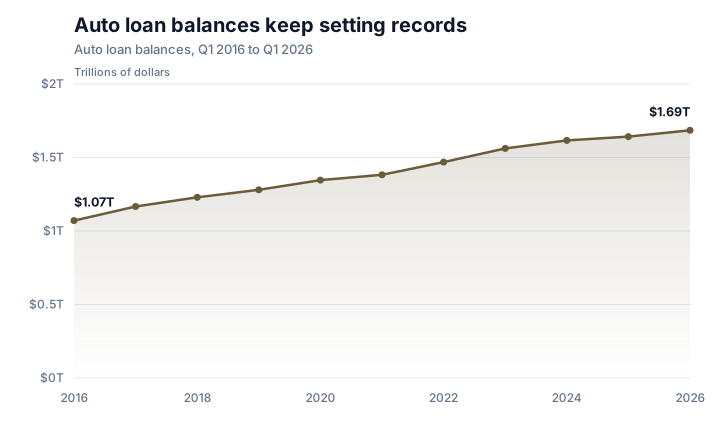
Source: New York Fed Household Debt and Credit Report data, Q1 2026.
Part of the increase is simply that cars cost more. Sticker prices climbed sharply over the past few years, and higher prices mean bigger loans. To keep the monthly payment manageable, lenders have stretched loan terms longer, with many new-car loans now running six or seven years. The average payment on a new car has climbed to a record $770 a month.
A car loan sits somewhere between a mortgage and a credit card. There is an asset behind it, which makes it safer than unsecured debt, but the asset loses value the moment you drive it off the lot. Stretch the term long enough and you can end up owing more than the car is worth for years, which is a tight spot if you need to sell or the car is totaled. Delinquencies here have been climbing too, especially among borrowers with lower credit scores.
Warning
The longer the loan term, the longer you spend "underwater," owing more than the car is worth. Rolling negative equity from an old car into a new loan makes this worse, because you start the next loan already behind. If you trade in or crash the car during that window, the payout may not cover what you still owe, leaving you paying for a car you no longer have.
Personal loans: the fastest-growing slice
Personal loans are the smallest category on this list, but proportionally they are growing the fastest. Unsecured personal loan balances hit a record $276 billion at the end of 2025, spread across 26.4 million borrowers, according to TransUnion. That is roughly double what borrowers owed in 2018.
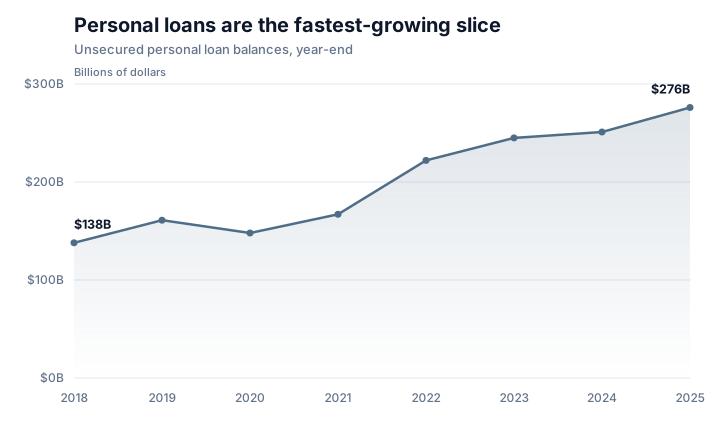
Source: TransUnion Credit Industry Insights Reports, year-end balances (Q4 2018 through Q4 2025).
Much of this growth has come from fintech lenders and from borrowers with lower credit scores, who led the increase in both new loans and balances. A large share of these loans is used to consolidate more expensive credit card debt. That can be a smart move. A fixed-rate personal loan at a lower APR than your cards, paid off on a set schedule, can save real money and get you out of debt faster.
Tip
Consolidation only works if the spending that created the debt actually stops. If you move a card balance onto a personal loan and then keep using the card, you end up paying both, and the total you owe climbs instead of falling. Before consolidating, make sure the loan's APR is genuinely lower than what your cards charge, and have a plan for keeping the cards paid off afterward.
Delinquencies in this category have been rising too, with the average balance per borrower around $11,700 and the 60-day-past-due rate reaching 3.99% at the end of 2025, up from 3.57% a year earlier. It is a useful tool that can also dig a deeper hole, depending on what comes after the loan clears the cards.
Student loans
Student debt accounts for one of the largest shares of household borrowing, so it deserves a closer look. At $1.66 trillion it is the third-largest category of household debt, larger than what Americans owe on credit cards, and it is carried by roughly 43 million federal borrowers.
It behaves differently from everything else on this list. Most of it is federal, which comes with income-driven repayment plans, deferment and forgiveness options that private debt does not offer. But after a multi-year pandemic pause, payments and collections have restarted, and delinquencies have jumped as borrowers adjust. Missed student loan payments show up on credit reports again, which has pulled down scores for millions of people.
Home equity lines of credit
Home equity lines of credit (HELOCs) account for a relatively small share of household debt. At $446 billion, only personal loans represent a smaller category. A HELOC lets you borrow against the equity in your home, so like a first mortgage it is secured by the property and sits on the safer end of the spectrum.
HELOC balances shrank for most of the 2010s, then started rising again a few years ago. The reason is interest rates. Homeowners holding cheap first mortgages do not want to refinance into today's higher rates, so those who want to tap their equity increasingly reach for a HELOC instead of a cash-out refinance, which would mean giving up the low rate on their main loan.
Delinquencies: the early warning sign
Behind every balance is the question of whether it is being paid on time. When a payment is missed the loan becomes delinquent, and lenders track how far behind it falls: 30 days, then 60, then 90 or more. The further it slips the more serious it gets. A payment 30 days late is often a one-off, but a balance 90 or more days past due is usually heading for collections, repossession or a charge-off, and it does lasting damage to a credit score. The chart below tracks that most serious stage across the main kinds of debt.
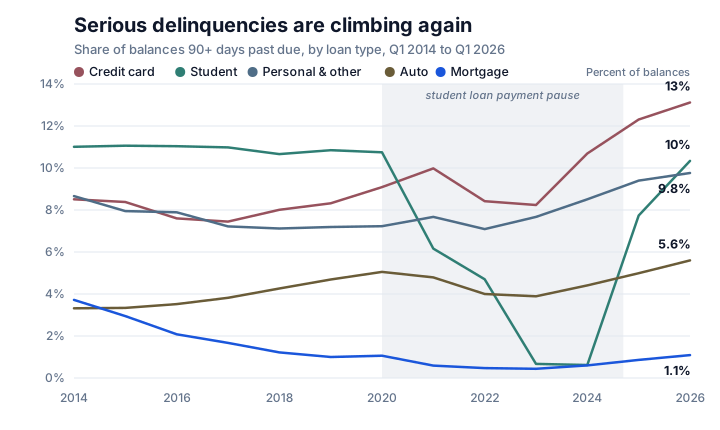
Source: New York Fed Quarterly Report on Household Debt and Credit, Q1 2026.
That is what makes delinquency a useful early warning sign for the wider economy. Serious delinquencies fell to lows around 2020 and 2021, when stimulus payments, paused student loan bills and mortgage forbearance left households with room to keep up. As that support faded, following a period of elevated inflation and higher interest rates, borrowers began to slip. The share of credit card balances 90 or more days behind has since climbed past 13%, the highest since the years right after the 2008 crisis, and auto loans have reached their worst level in the more than two decades the New York Fed has tracked.
The strain is not spread evenly, which is the other half of the story. Mortgages, backed by a home the owner wants to keep and mostly locked into low fixed rates, have stayed near 1%. The pressure is concentrated at the unsecured, higher-rate end: credit cards, along with the personal loans, retail cards and other consumer debt the New York Fed reports together as "personal & other" on the chart. Auto loans sit in between, and car loans taken out in 2022 and 2023, at peak prices and high rates, have gone bad at some of the fastest rates in years. Student loans are a case of their own. Delinquencies were not reported during the long payment pause, so the rate looked artificially close to zero, then jumped once reporting resumed in 2025 and marked millions of borrowers behind almost overnight.
None of these levels are a 2008-style emergency yet. But away from mortgages the direction is the same across nearly every kind of debt, and a broad rise in serious missed payments is the clearest sign that more households are stretched than the headline balances alone let on.
What it adds up to
Record household debt is not, on its own, a crisis. Most of that $18.8 trillion is mortgage debt, tied to homes that have gained value and locked in at rates that will not move. Debt used to purchase an appreciating asset is fundamentally different from debt used to finance day-to-day consumption.
The part worth watching is the mix. Mortgage balances rise roughly in step with home values, but debt from credit cards, auto loans and personal loans have continued to grow alongside rising living costs and delinquency rates have increased across each.
If you are carrying any of it, the order of priority is usually clear: clear the high-rate revolving debt first, be careful about stretching a car loan just to shrink the payment, and only consolidate if the underlying spending has genuinely changed. And if you do need to borrow, it pays to compare offers rather than take the first one in front of you. Our loans page and free calculators are built to help you see the real cost before you sign, so the total you owe is money working for you rather than against you.