
Why are APRs on secured credit cards so high?
A secured card is backed by your own money, so why is the APR still near 30%? What 21 offers charge, and what that says about credit card pricing.
I spend a fair amount of time on personal finance subreddits. One question that comes up regularly is: what is the best way to build credit? My usual recommendation is to skip the gimmicky "credit builder" products and apply for a secured credit card. As I have written before, that's what I did when I moved to the US in 2018. I had no credit history, so no bank would trust me with their money. But I was able to use my savings to get a Discover it Secured card to build my credit profile (and get double cashback in my first year!). About six months later, my deposit was returned and I "graduated" to the unsecured Discover it Chrome card.
In my Reddit answer, I was also planning to mention that secured cards have lower APRs. If you did carry a balance, you would therefore pay less interest than you would on a standard credit card. For someone with limited or damaged credit history, that could save them a considerable amount of money. It made sense to me: because the card is secured by the applicant's own funds, surely the rate should be significantly lower. But like any good Reddit commenter, I decided to do some extensive research before posting.
Rather than confirming my assumption, I found secured cards charging much the same APRs as unsecured cards, often well into the high twenties. Digging deeper, I learned that credit card APRs appear to vary surprisingly little with the risk the bank is actually taking. Issuers compete aggressively on rewards and sign-up bonuses because those are the things most of us notice. APR receives far less attention, which gives banks little reason to lower it. What began as a question about secured cards became a story about how banks make money from the things we notice and the things we ignore.
What a secured card is and who uses one
A secured card is a normal credit card with one extra step. Before you can use it, you deposit money with the bank, usually the full amount of your credit limit, and the bank holds it as collateral. You still get a bill each month, you still pay interest if you do not clear the balance, and the bank still reports your payments to the credit bureaus, which is what builds your credit. The difference comes if you stop paying: the bank will take the deposit to cover what you owe. That is a last resort rather than a first response. The deposit is only liquidated once the account is closed and charged off, usually after 180 days past due.
Because the line is backed by cash, the approval bar is low, making the product a popular choice for people with limited or damaged credit history. The Philadelphia Fed, which tracks the market through the account-level data the largest banks report to the Federal Reserve, finds that more than half of new secured cards go to people with no credit score at all, that roughly half of those who do have a score are below 580, and that half of new cards start with a limit of exactly $200 (2024 update). It is a small market. The largest banks held 3.7 million secured cards with $817 million of balances in September 2023. At the large institutions that offer them, secured cards are about 2% of general purpose cards and less than a third of 1% of outstanding balances, but they are an important entry point for those with thin files or bad credit history.
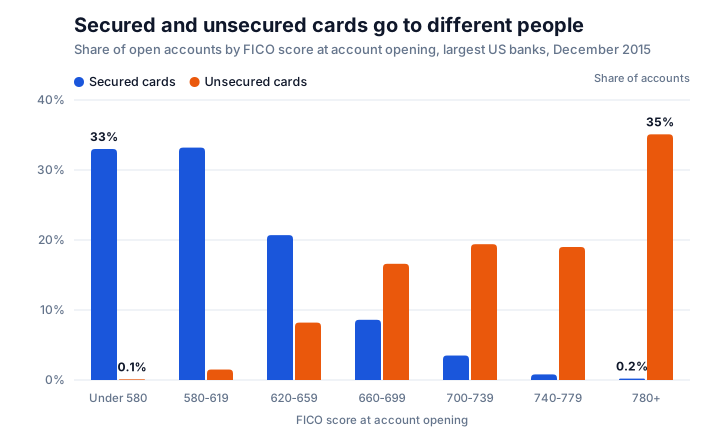
Source: Philadelphia Fed, The Secured Credit Card Market (2016), Figure 3, values read from the published chart. Accounts with a FICO 08 score at opening, so people with no score at all, who make up more than half of new secured cardholders, are not on it.
That leaves secured cards in a strange position: the customers look risky, but the money the bank lends is unusually well protected. The question is how much weight the deposit gets in the rate.
What secured cards charge today
Credit card APRs, secured or unsecured, are made up of two parts: the prime rate plus a margin. Prime largely follows Federal Reserve policy rather than any decision by the issuer. The margin is entirely the bank's, and in theory it reflects the risk that a given applicant will not pay, which is the idea behind risk-based pricing.
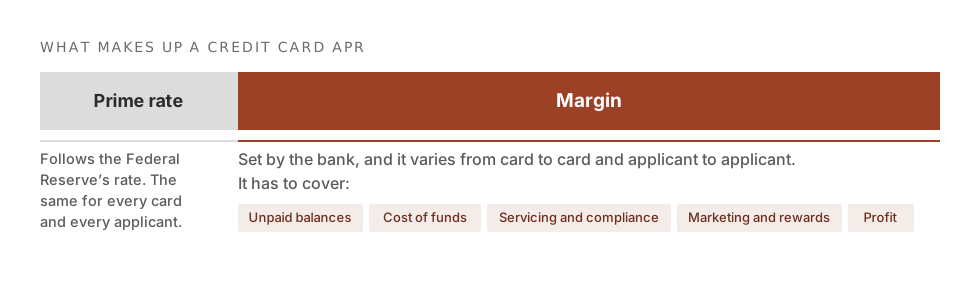
Here is what the market looked like on 14 September 2026, with prime at 6.75%. The numbers are purchase APRs, taken from each issuer's own product page or cardmember agreement and linked in the first column. Two of the twenty-one are not conventional secured cards: Chime's card does not lend at all, settling each purchase from money you have moved into its secured account, and Synchrony's Amazon card is a store card that only works at Amazon.
| Card | APR | Fee | Min deposit | Rewards |
|---|---|---|---|---|
| Chime Card credit-builder card, no revolving |
None | $0 | Whatever you move across | Up to 5% in one category |
| Amazon Secured Card Synchrony, store card |
10.00% | $0 | $100 | 2% at Amazon with Prime |
| First Progress Platinum Prestige | 13.49% | $49 | $200 | 1% on payments |
| Affinity FCU Secured Visa credit union, $5 to join |
14.10% | $0 | $250 | None |
| First Progress Platinum Select | 17.49% | $39 | $200 | 1% on payments |
| Navy Federal cashRewards Secured | 18.00% | $0 | $200 | 1% on everything |
| Merrick Bank Secured | 21.95% | $36, then $3 a month | $200 | None |
| OpenSky Secured Visa | 23.89% | $35 | $200 | None |
| Citi Secured Mastercard | 25.99% | $0 | $200 | None |
| Regions Explore Visa | 26.49% | $29 | $250 | None |
| TD Cash Secured | 26.49% | $29 | $300 | 3% and 2% in chosen categories, 1% else |
| Truist Enjoy Cash Secured | 26.74% | $0 | $400, equal to your limit | 3% and 2% in set categories, 1% else |
| Bank of America Customized Cash Rewards Secured | 27.49% | $0 | $200 | 3% chosen and 2% set category, 1% else (6% in year one) |
| U.S. Bank Secured Visa | 27.49% | $0 | $300 | None |
| Self Visa | 27.49% | $0, then $25 | $100 | None |
| Fifth Third Secured | 27.49% | $24 | $300 | None |
| U.S. Bank Cash+ Secured | 28.49% | $0 | $300 | 5% and 2% in chosen categories, 1% else |
| Discover it Secured relaunched |
28.99% | $0 | $49 to $200 for a $200 line | 5% rotating, 1% else, matched in year one |
| Capital One Platinum Secured | 28.99% | $0 | $49, $99 or $200 for a $200 line | None |
| Capital One Quicksilver Secured | 28.99% | $0 | $200 | 1.5% on everything |
| Credit One Bank Secured | 29.74% | $0 | $200 | 1% in set categories |
A note on timing
The rates in this table were checked on 14 September 2026, when the prime rate was 6.75%. Most are variable and generally move by the same amount when prime changes, although issuers apply changes on different schedules. Amazon's 10% APR is fixed.
Thirteen of the 21 cards charge between 25.99% and 29.74%. For context, the average new general purpose card opened in 2024 carried 27.5%, and the average card held by someone with a subprime score was 29%. Most secured cards land in that same territory, deposit or no deposit.
Does the deposit justify a lower rate?
That makes secured cards look very expensive, and whatever the deposit buys, it does not seem to be a lower rate. But before concluding that banks are simply overcharging, it is worth asking what the deposit does not cover.
- Riskier people, even if the loan is safer. In the Fed's 2015 snapshot, 10.3% of secured accounts were behind on payments, against 4.9% of unsecured ones.
- Some losses are real. Not every card is fully secured, a balance can run past the collateral after a credit line increase, and interest and fees can push the total owed beyond the deposit.
- Fixed costs do not shrink with the limit. Statements, servicing, bureau reporting and fraud monitoring cost the same on a $200 line, and the CFPB has recorded outside research finding secured portfolios "have slim, and sometimes negative, profit margins in the short term", though several big issuers told the Bureau their portfolios were "independently profitable".
- The collateral may already be priced into a waived fee. Annual fees are one way banks charge for risk, and secured cards have shed theirs: 79% of new secured cards carried one in 2015, 4% in 2022. Banks may be recovering the lost fee income through a higher APR.
- The best customers leave soonest, by design. Graduation skims off the reliable payers, so the accounts left behind are riskier than the ones that opened.
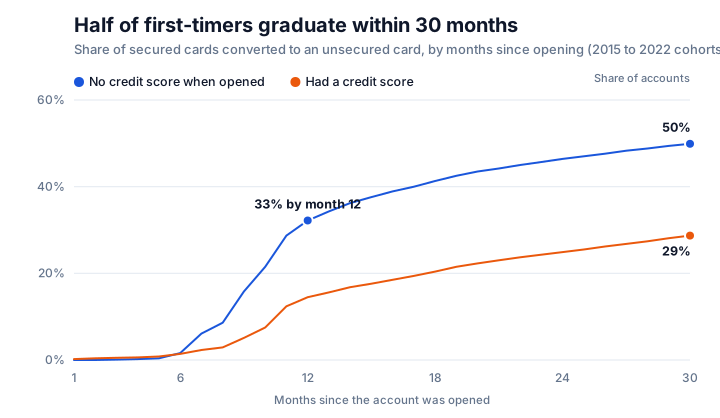
Source: Philadelphia Fed, Secured Card Market Update (2024), Figure 15, values read off the published chart. Cohorts opened 2015 to 2022.
The deposit does not eliminate every cost. But it changes the most important one: how much the bank stands to lose in the event of non-repayment.
- The deposit takes most of the principal risk off the table. The CFPB found the majority of secured cards fully secured at opening, giving the issuer "recourse equivalent to the entirety of the consumer's outstanding balance" in a default. On an unsecured card, the roughly 6% of balances charged off each year fall on the issuer.
- The cash costs the bank very little. Deposits normally cost a bank interest, and in 2017 the CFPB wrote that "no mass market bank issuer places the security deposit in an interest-bearing account". Several now do, including U.S. Bank, Regions, Credit One, Navy Federal, Truist, TD and Fifth Third. The rate can be negligible, however, so it is worth checking the product page for what an account pays today.
- The card still earns swipe fees every time it is used. Known as interchange, they are a slice of every purchase, about 1.8%, paid by the merchant to the bank that issued the card.
Add it up and the deposit ought to be worth something in the price. Whether it is depends on which issuer you ask, and two of them answer in opposite ways.
A tale of two issuers
Synchrony's Amazon Secured Card sits near the bottom of the table at 10%, and it is the clearest evidence that a bank can price the deposit in if it wants to. The same account has two sets of features. While your deposit is in place it charges 10%. After at least twelve months and another eligibility check, qualifying customers can switch to unsecured store-card features at prime plus 22.74%, which is 29.49% today. Other terms change with the switch too, so the nineteen-point gap cannot all be put down to the deposit, and Amazon may treat the secured card as a loss leader. Even so, at least one large issuer is willing to price a fully secured card far below prevailing subprime rates.
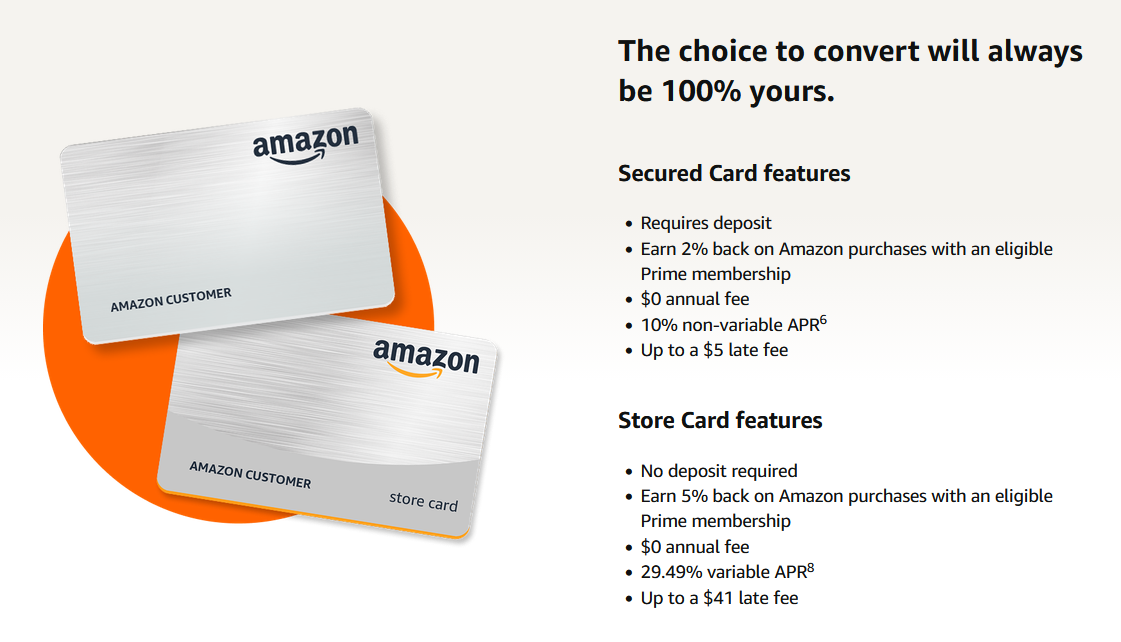
Source: Amazon's product page, as shown on 14 September 2026.
Capital One, on the other hand, advertises no such discount. It sells two secured cards and, beside them, two unsecured cards its pages label "fair credit". Each page states one variable rate rather than a range, so this is a comparison between products as advertised, not between applicants.
| Card | Min deposit | APR | Fee | Rewards |
|---|---|---|---|---|
| Platinum unsecured |
None | 28.99% | $0 | None |
| Platinum Secured |
$49 | 28.99% | $0 | None |
| QuicksilverOne unsecured |
None | 28.99% | $39 | 1.5% |
| Quicksilver Secured |
$200 | 28.99% | $0 | 1.5% |
Source: Capital One's own side-by-side comparisons of the Platinum and Quicksilver pairs, as published on 14 September 2026. The two unsecured cards are the ones the pages market to "fair credit".
Within one issuer, the deposit produces no advertised reduction in the APR. On the Quicksilver pair it coincides with the removal of a $39 annual fee, and Platinum Secured's deposit of $49, $99 or $200 for a $200 line depends on the applicant's credit history, so Capital One may be managing risk through the size of the deposit rather than the rate. Synchrony advertises a rate almost nineteen points lower while the deposit is in place. Capital One advertises the same 28.99% on all four products.
It was not always like this
Secured card APRs in the high 20s have not always been the norm. When the Philadelphia Fed took its first snapshot in December 2015, 95% of the secured cards then open carried a rate between 15% and 25%, and almost none were priced above it, while 14.4% of unsecured cards were. Secured cards cost more than the typical unsecured card, but almost none were priced like a subprime one. By 2022, 80% of new secured cards were priced at 25% or more.
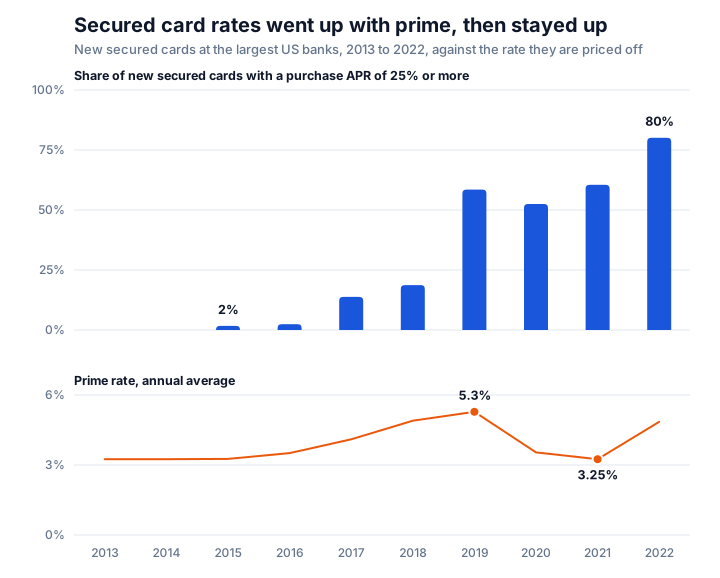
Source: Philadelphia Fed, Secured Card Market Update (2024), Figure 8, with the yearly values read off the published chart; prime rate from FRED, averaged by year.
Part of that is the interest rate cycle: almost every secured card is priced off prime, and prime climbed from 3.25% to 5.5% between late 2015 and 2019. But prime fell back to 3.25% in March 2020 and stayed there through 2021, and the share of new secured cards at 25% or more barely moved. The Fed's researcher put it plainly: the share "changed little when the prime rate later fell". The pattern is what you would expect if issuers had raised the margin, the part of the price they control, and left it there.
While rates rose at the largest banks, annual fees fell away and rewards became more common.
| New secured cards | 2015 | 2022 |
|---|---|---|
| Charged an annual fee (p. 16) | 79% | 4% |
| Came with rewards (p. 17) | 14% | 31% |
| Priced at 25% APR or more (p. 15) | 2% | 80% |
Source: Philadelphia Fed, Secured Card Market Update (2024). The 2015 annual fee figure is read from the report's Figure 9; the others are stated in the text.
Annual fees, once near universal, have almost vanished, and rewards are on a third of new secured cards. The loss of fee income may explain part of the rise in APRs, but not all of it, as the fee-free Amazon cards show. For the full picture, you have to look beyond secured cards.
What the wider card market tells us
Secured cards are a tiny slice of the overall market, so their prices are far more likely to follow the industry's trends than to set them. Every two years the CFPB reports to Congress on the card market as a whole, and its latest report shows the average rate on new cards by the credit score of the person who opened them, in 2014 and again in 2024.
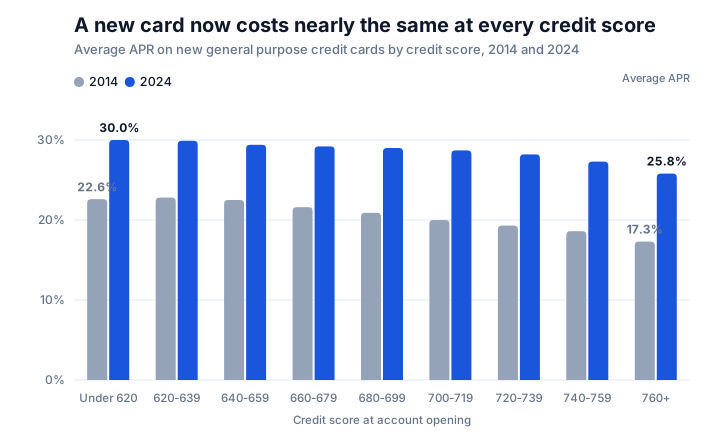
Source: CFPB, The Consumer Credit Card Market (December 2025), Figure 85, Y-14 data on the largest banks.
In 2014 the gap between a score under 620 and a score over 760 was 5.3 percentage points. By 2024 it was 4.2, and every band had moved up by seven to nine points. In the CFPB's words, the larger increases in the margin at the top "have led to less differentiated pricing based on risk". A four-point gap suggests that borrower risk produces a surprisingly small difference in the average rate on a newly opened card. Seen that way, Capital One charging the same 28.99% with or without a deposit is a clear example of a wider pattern.
Other kinds of credit show what stronger risk pricing looks like. Experian's auto lending data for the first quarter of 2026 put the average new-car loan at 4.55% for the best scores and 16.01% for the worst, and the average used-car loan at 6.30% against 21.77%. The worst tier pays about three and a half times the best tier's rate. On a new credit card in 2024 it paid about a fifth more. An auto loan is secured by the car, so the two products are not alike, but the difference in how steeply risk is priced is hard to miss.
| Average APR | Best | Worst | Ratio |
|---|---|---|---|
| New credit card 2024 |
25.8% | 30.0% | 1.2 |
| New-car loan Q1 2026 |
4.55% | 16.01% | 3.5 |
| Used-car loan Q1 2026 |
6.30% | 21.77% | 3.5 |
Source: CFPB, The Consumer Credit Card Market (December 2025), Figure 85; Experian, State of the Automotive Finance Market, first quarter of 2026, as published on its auto loan rates and used car loan rates pages, VantageScore 4.0 tiers. Best and worst are the top and bottom score tiers each source reports: 760 and above against under 620 for cards, 781 and above against 300 to 500 for auto loans. The ratio is the worst tier's rate divided by the best tier's.
So credit cards are priced quite differently from auto loans: borrower risk plays a much smaller role. Let's look at how the card industry actually makes its money.
Credit cards are good business
Maybe credit cards are simply riskier than other forms of lending, and rates are high across the board because losses are too. The Federal Reserve has tracked the profitability of the big card banks since 2001. Even after accounting for those losses, the returns suggest that risk is not the whole explanation: credit cards usually earn several times what banks make on everything else.
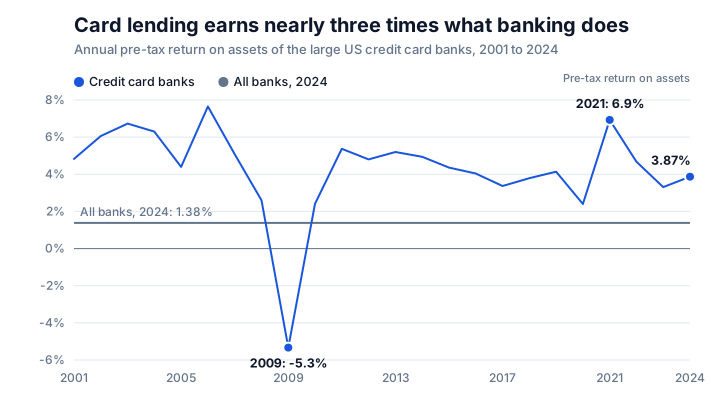
Source: Federal Reserve, Profitability of Credit Card Operations of Depository Institutions (November 2025), Tables 1 and 2.
A team from Wharton, Columbia and the New York Fed checked whether losses justify the rates, using the lifetime cash flows of 550 million accounts at the 20 largest banks. Charge-offs run at about 6% a year, but they "explain only a fraction of cards' spread". In their words, "operating expenses, particularly marketing, are very large and are used to generate pricing power". Banks spend heavily to make you choose a card on something other than price, and it works well enough that the price varies less with risk than it used to. The paper looks at the whole card market, not secured cards specifically, but it is the best available explanation for why the deposit buys so little.
The marketing sells rewards: cashback, points, a welcome bonus, the things that make one card feel different from another. But banks make most of their money on interest from people who carry a balance.
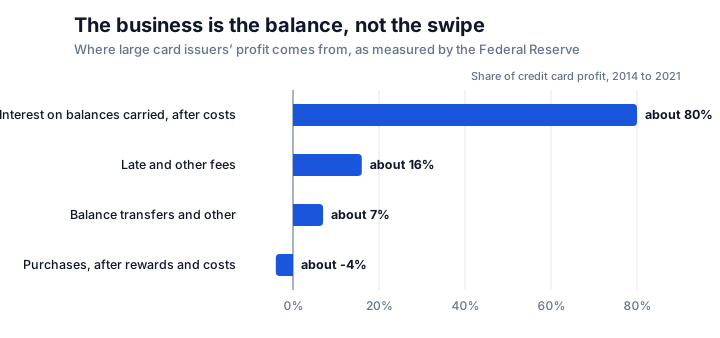
Source: Federal Reserve FEDS Notes, Adams, Bord and Katcher, Credit Card Profitability (September 2022). Shares are approximate, as the authors present them.
And the interest side has grown fast, from a combination of bigger balances and higher rates. The bars show the last three months of each year; for the whole of 2024 the figure was over $160 billion.
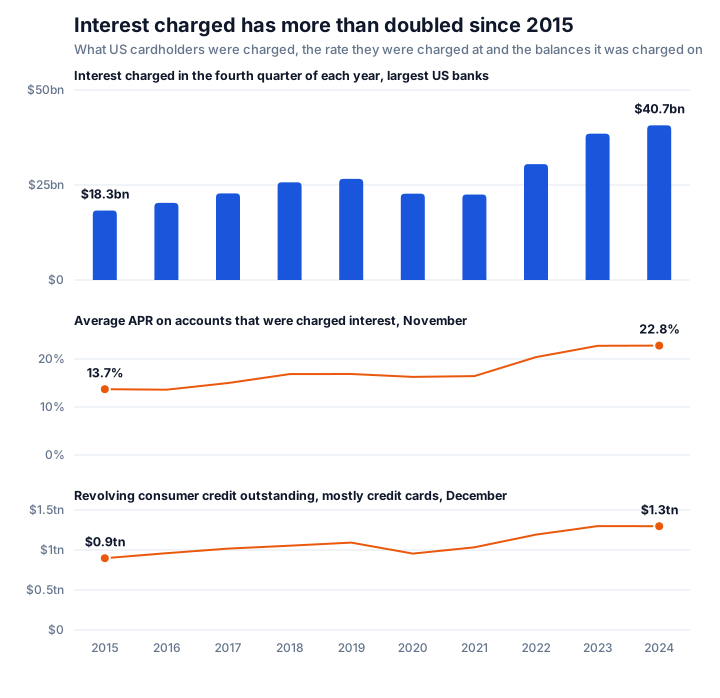
Source: CFPB, The Consumer Credit Card Market (December 2025), Figure 21, interest assessed in the fourth quarter of each year, Y-14 data on the largest banks; Federal Reserve via FRED, interest rate on credit card plans, accounts assessed interest (November of each year) and revolving consumer credit outstanding (December).
Banks did hand more back as they competed on rewards, nearly doubling the value earned between 2020 and 2024. But in dollars, the rise in interest charges over those four years was larger than the entire rewards bill. The two totals are drawn from different sets of cards, so this is a rough comparison rather than an exact one.
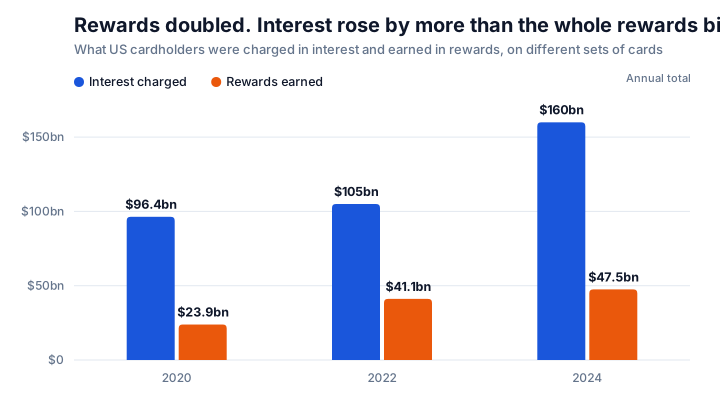
Source: CFPB, The Consumer Credit Card Market (2023) and (2025), Y-14 data on the largest issuers. Interest covers all cards in the data; rewards are those earned on general purpose cards at mass market issuers, so co-brand airline and hotel points run by the partner are not counted.
That is the business a secured card is sold into. The deposit lowers the bank's risk, but it does nothing to change where the bank's profit comes from, and nothing in the marketing invites you to ask about the rate. That brings me back to the Reddit question: knowing all of this, would I still recommend a secured card?
The answer I would post now
My answer is still yes, but with an important caveat. When I chose my own secured card in 2018, I knew it was a stepping stone to a better card and wanted to maximise that sweet, sweet cashback. I never looked at the APR. I have always paid my card in full, so the rate never mattered to me.
I was hardly unusual. Cards are sold on rewards, while the APR is rarely part of the marketing pitch. Samuel L. Jackson never tells you the rate on the Capital One Savor card; but he does tell you it earns 3% cashback on chicken and risotto. NerdWallet's comparison table of the best rewards cards has columns for the annual fee, the rewards rate and the intro offer, and none for the APR. On its main best-cards page the rate does appear, in a second row below the rewards and the intro offer. Given that we were charged $160 billion in card interest in 2024, I think we could all afford to check the APR before we apply.
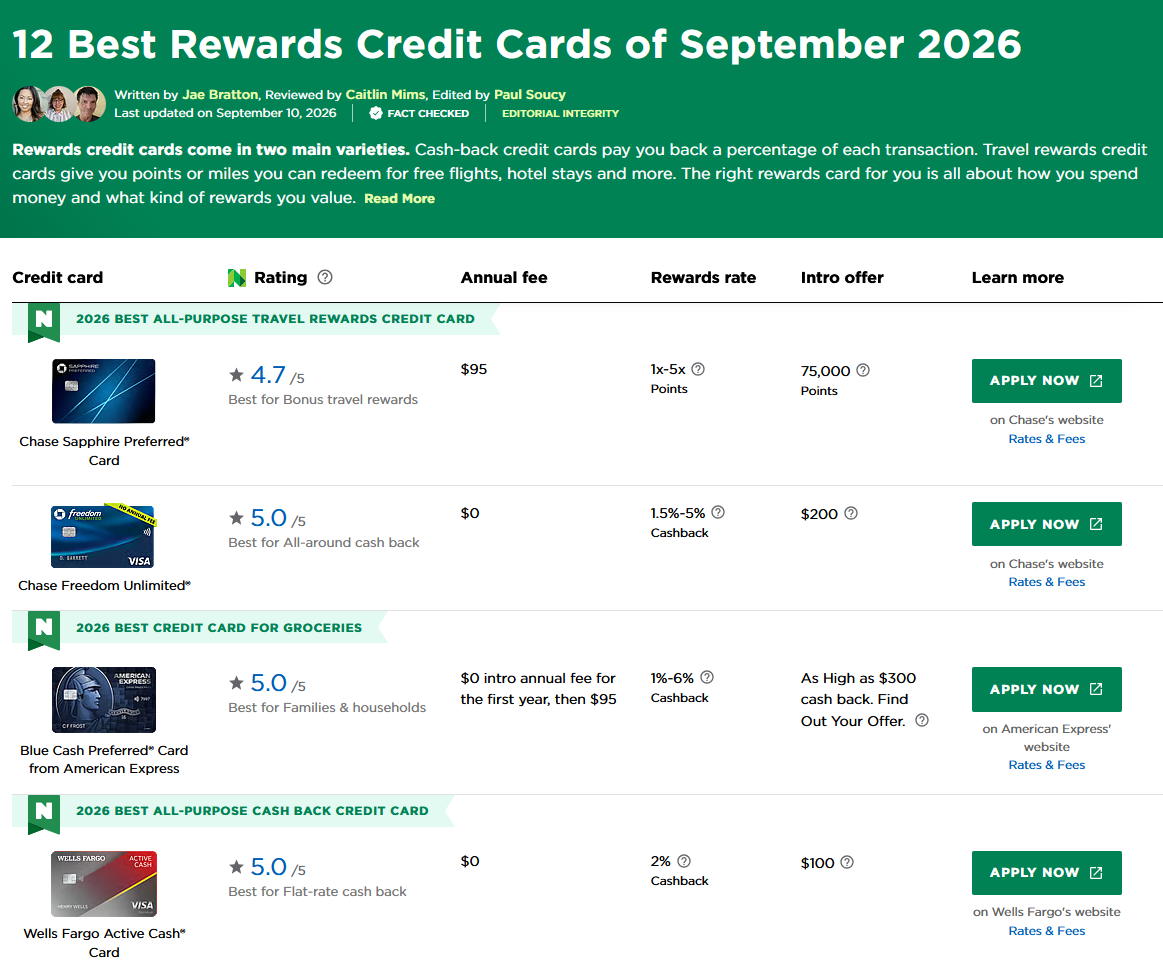
Source: NerdWallet's best rewards credit cards, as shown on 14 September 2026.
Marketing encourages us to weigh the perks in front of us more heavily than the cost behind them, but some of this is on us. Around half of all card accounts carry a balance from one month to the next. If that is you, don't be distracted by the promise that today's spending will help pay for a fancy hotel on some Greek island: at 29%, a few months of interest can swallow a year's rewards. I suppose few people apply for a rewards card expecting to carry a balance, just as nobody joins a gym expecting to stop going. Both decisions are made by the person we intend to be, though reality often plays out differently.

Source: Capital One, Venture X Card, Globe Hopping 3.0, posted February 2025. The Jennifer Garner voiceover does not mention the interest rate.
Secured cardholders are no different: four months after opening, about half of those who had a credit score are already carrying a balance. It does seem perverse. Let's play it out. Imagine someone who has recently arrived in the US and wants to start building credit. They put up $200 of their own savings for a secured card and spend $100. Then something unexpected comes up, a car repair or a medical bill. With their savings tied up as collateral, they have less of a buffer to absorb it and they fall behind on payments. The bank adds interest and missed payment fees just as it would on an unsecured card, eventually bringing the amount owed to $150. The account is then closed, the bank takes $150 from the deposit and returns the remaining $50, leaving the cardholder with severely damaged credit. These are vulnerable borrowers making a sound decision and putting up their own money, and they are charged as though they were gambling with the bank's, when very little of the bank's money is at risk.
So here is the answer I would post. A secured card is still one of the simplest ways to build credit, but I won't tell people that putting down a deposit guarantees them a cheaper rate. Check the APR and aim to pay the balance in full each month. The cheapest revolving card in my table is Amazon's at 10%, which only works at Amazon; Affinity's 14.10% Visa can be used anywhere Visa is accepted. If you can, choose a card that prices your collateral as though it actually matters.