
Simple vs Compound Interest: What's the difference and why it matters
Compound interest earns interest on your interest, while simple interest does not. Here is why it matters for debt and savings.
Someone once said "Compound interest is the eighth wonder of the world. He who understands it, earns it... he who doesn't... pays it." It's typically attributed to Einstein, who probably never said it, much like most of his best quotes. But you don't need to be Einstein to appreciate the benefits (and pitfalls) of compound versus simple interest.
It turns out the difference between the two is one of the quietly important ideas in personal finance. It helps explain why credit card debt can feel like it grows faster than you can pay it down and why money set aside for retirement can grow into far more than you ever put in.
Compound interest sounds more complicated than simple interest, but the idea behind it is not hard to follow. Once you have seen how each one works, you will start noticing it everywhere. Here is what simple and compound interest actually mean and why they are worth caring about.
Simple interest
As the name suggests, simple interest is the straightforward version. Interest is only ever calculated on the amount you started with, known as the principal. It never earns interest of its own.
The formula is about as friendly as finance formulas get:
Interest = Principal × Rate × Time
Example
You have $10,000 earning 10% simple interest for 3 years. Each year you earn 10% of the original $10,000, which is $1,000. Over three years that is $1,000 + $1,000 + $1,000 = $3,000 in interest, leaving a total of $13,000.
Because the interest is always calculated on that original $10,000 and nothing else, it grows in a straight line. Year one, year two and year three each add the same $1,000. Simple (hence the name) and predictable.
Compound interest
Compound interest is where things get more powerful, for better or worse. Here the interest is added to your balance and the next round of interest is calculated on the new, larger balance. In other words, you start earning (or paying) interest on your interest.
Example
You have $10,000 earning 10% interest, compounded once a year. After year one you earn $1,000, taking you to $11,000. In year two the 10% is applied to $11,000, so you earn $1,100, reaching $12,100. In year three you earn $1,210, ending at $13,310.
Compare that to the simple interest example. Same starting amount, same rate, same three years. Simple interest left you with $13,000. Compound interest gets you to $13,310. That $310 gap looks small after only three years. Over decades, or on a larger balance, the difference becomes dramatic. That snowball effect is the whole story of compound interest.
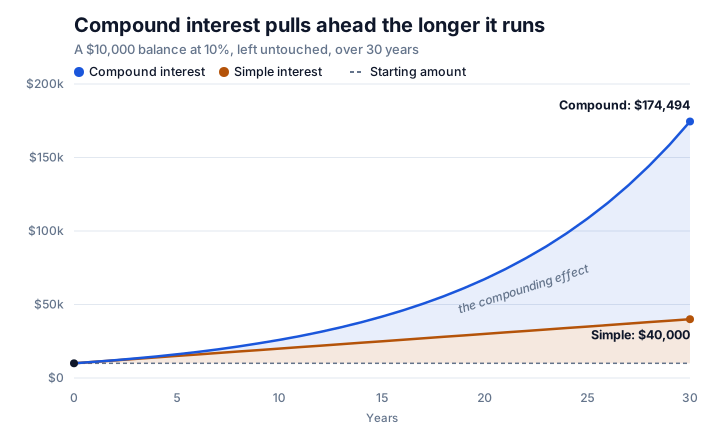
Illustrative example. Simple interest is charged only on the original $10,000; compound interest is added to the balance and compounds once a year.
Want to try your own numbers? The Compound Interest Calculator draws this same comparison live and lets you change the amount, rate and how often it compounds.
The compounding period
If interest can compound, the next question is how often. This is the compounding period, or frequency, and it can be annual, monthly, daily or almost anything in between. It can make a big difference to the final total.
The more frequently interest compounds, the faster the balance grows. Interest gets added sooner, so it starts earning its own interest that much earlier.
Example
Take $10,000 at 10% for one year. Compounded once a year it grows to $11,000. Compounded monthly it reaches about $11,047. Compounded daily it reaches about $11,052. Same rate, same year, different frequency.
The differences are modest over a single year, but they build over time and grow with the balance.
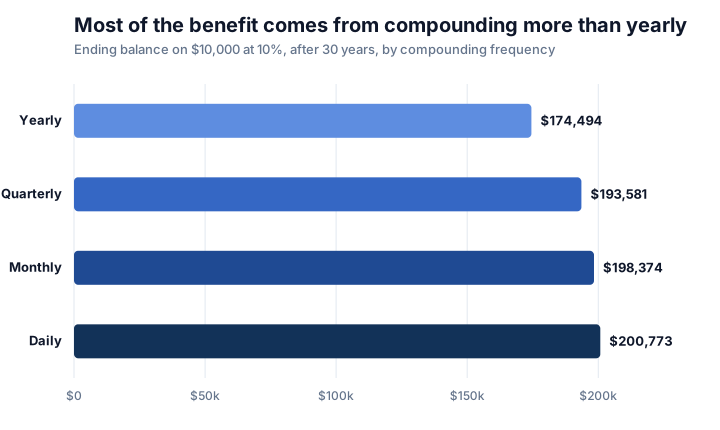
Illustrative example. The same $10,000 at 10% as the chart above, compounded yearly, quarterly, monthly or daily. Each step up in frequency adds less than the last because more frequent compounding approaches a natural ceiling.
This is also why savings and loans advertise the numbers they do. Savings accounts often quote an APY (annual percentage yield), which folds the compounding in, so it reflects what you would actually earn over a year. Loans usually quote an APR (annual percentage rate), which works differently: it captures the interest rate and most fees, but it does not include the effect of compounding.
Why it matters
Compound interest is the same mechanism whether it is helping you or hurting you, regardless of which side of the balance you are on.
When you are borrowing, compounding works against you. Paying interest on top of interest you already owe is exactly as bad as it sounds. This is the trap people fall into with credit cards. You carry a balance, you get charged interest, and that interest joins the balance so next month you are charged interest on it too. Fall behind and the balance can seem to take on a life of its own.
Warning
On a credit card, paying only the minimum is where compounding does the most damage. Paying even a little more than the minimum each month means future interest is calculated on a smaller balance, helping you clear the debt much faster.
When you are saving or investing, the very same effect becomes your friend. You may have heard compounding described as the closest thing to a free lunch in finance. It is why starting to save early matters so much for retirement. Money left alone for thirty years does not just grow, it grows on its own growth, again and again.
This website mainly focuses on debt and the lesson for borrowers is clear: when interest compounds against you, paying it down sooner rather than later saves you more than the raw numbers first suggest. The way interest is calculated is one of the things that decides how expensive it becomes to carry debt over time, alongside fees, the length of the loan and how quickly you pay it down.
So which is better? Neither, really. Compound interest works in your favor on savings and against you on debt. It is the same force behind savings that build into real wealth over the years or a debt that spirals beyond what you borrowed. It is the exact same calculation either way. All that changes is whether you are earning it or paying it.
Where you'll run into each one
So where does each one actually show up? Details vary by lender and product, so treat this as a guide rather than a guarantee and always check your own agreement.
Most installment loans, the kind you pay off in fixed monthly payments, use simple interest. That includes personal loans, most auto loans and standard mortgages. Interest is calculated on your outstanding principal balance. As long as payments are made as agreed, unpaid interest does not accumulate, so interest generally does not compound. Each payment covers that month's interest and chips away at the principal, so there is no leftover interest to snowball.
Credit cards are the classic compounding product, and they typically compound daily. If you pay your statement balance in full by the due date, you will usually pay no purchase interest at all thanks to the grace period. That is one of the most useful things to know about a credit card. Carry a balance, though, and daily compounding is what makes credit card debt so costly. It is one of the reasons a personal loan can be a cheaper way to borrow than leaning on a card.
Federal student loans use simple daily interest, but with a catch. Unpaid interest can be capitalized at certain points. Once that happens, the unpaid interest becomes part of your principal, and future interest is calculated on that larger balance. It pays to stay on top of the interest before it capitalizes.
On the savings side, most accounts work in your favor. Savings accounts, high-yield savings accounts, money market accounts and CDs almost all compound, usually daily or monthly.
Tip
You do not need to track how often a savings account compounds. The quoted APY already includes the compounding effect, so comparing APYs compares like for like.
The table below sums up which products compound and whether that works for you or against you.
| Product | Simple or compound | Typical frequency | For or against? |
|---|---|---|---|
| Personal loan | Simple | Charged on the principal balance | For you |
| Auto loan | Simple | Charged on the principal balance | For you |
| Mortgage | Simple | Charged on the principal balance | For you |
| Federal student loan | Simple, but interest can capitalize | Daily accrual | For you |
| Credit card | Compound | Daily | Against you |
| Savings / high-yield savings | Compound | Daily or monthly | For you |
| CD (certificate of deposit) | Compound | Daily or monthly | For you |
Summary
Simple interest is calculated only on the amount you started with. Compound interest is calculated on that amount plus the interest already added, so each round of interest becomes part of the balance that earns the next round. The compounding frequency decides how quickly that happens.
If you remember one thing, make it this: compounding is a wonderful thing to have working for you and a costly thing to have working against you. Aim to be on the earning side of it where you can, and when you are on the borrowing side, especially with anything that compounds daily like a credit card, paying it down early is worth more than it looks.
Understanding how interest is calculated will not clear a debt on its own, but it will help you spot which borrowing options are likely to cost more over time, so you can make a more informed decision before you sign anything.